Studies > Science & Bible
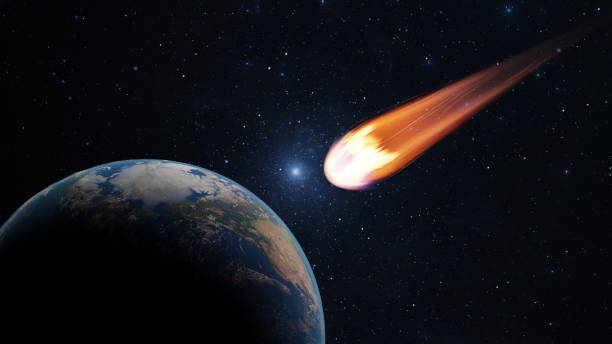
Science and the Wormwood Star Prophecy
by Marshall Beeber
Introduction
In the First Century AD, the Apostle John wrote an apocalyptic book called "Revelation" in which he described among many "end-time" events the collision of a star called Wormwood with Earth. Revelation states:
Rev. 8:10-11: The third angel sounded his trumpet, and a great star, blazing like a torch, fell from the sky on a third of the rivers and on the springs of water-- the name of the star is Wormwood. A third of the waters turned bitter, and many people died from the waters that had become bitter.
Wormwood is a botanical herb commonly known for its bitterness. See Botanical.com. It was used as a pesticide, medicinal tonic and liqueur ingredient. The term "wormwood" was often used to describe "extreme bitterness". Let us consider the possibility of a "star" turning the waters bitter on Earth. The term "star" in classical terminology lacks the modern astronomical sense. It could have been referring to a comet, asteroid, "sun-like" star or planet. Since the possibility of a planet or sun colliding with earth is infinitesimal, we will eliminate this possibility.
A Scientific Explanation For The Wormwood Star
The Wormwood prophecy cites a "great star, blazing like a torch". Comets are well known for their blazing tails, due to ionization of their gases by the Sun. Either an asteroid or comet could manifest a blazing tail on their entry into Earth's atmosphere. With respect to a comet's impact with a planet, astronomers have recently tracked the collision of the "Shoemaker-Levy 9" comet with the planet Jupiter and were able to confirm many of their theories.
Various scientific scenarios have been theorised on the effects of an asteroid or comet's collision with Earth. An applicable scenario theorizes a chemical change in the atmosphere due to "heat shock" during entry and/or impact of a large asteroid or comet, reacting oxygen and nitrogen in the atmosphere to produce nitric acid rain. The bitterness produced by the Wormwood Star upon a third of the Earth's potable waters could be the Biblical prediction of "acid rain" from the "heat shock" of a large comet or asteroid's impact with Earth.
The Hooper Natural Science Museum in Ottawa, Canada cites a scientific theory that postulates "atmospheric chemical changes" from the impact of an asteroid or comet with the Earth. This scientific theory was derived by two M.I.T. scientists.
In 1987 M.I.T. astronomers Ronald Prinn and Bruce Fegley determined the atmospheric consequences of both large and small asteroid and comet impacts. When an asteroid enters earth's atmosphere there are two occurrences of extreme shock. The first occurs as the asteroid enters the atmosphere. The second, more important one, occurs when the ejecta plume (the ejected debris caused by an impact) enters the atmosphere (Dr. Kevin Zahnle, 1990). This shock causes the breakdown of the oxygen (O2) and the nitrogen (N2) molecules found in our atmosphere. Through a series of chemical reactions the dissociation of the nitrogen and oxygen forms NO which is then converted into NO2. These two molecules can produce nitric acid rain (HNO3). They assumed the "large" impact comet had a mass of 1.25 x 10¹⁶ Kg traveling at a velocity of 65 Km/s. As for the "small" impact asteroid, they assumed it had a mass of 5 x 10¹⁴ Kg traveling at a velocity of 20 Km/s. It is important to note that these two objects are possible bolides that hit the earth 65 million years ago.
Conclusions of the Large Comet Impact Scenario
If the "large" comet impact scenario occurred, 7 x 1040 molecules of NO would have been produced and subsequently converted into acid rain. (See chemical reactions) This would have caused a global dispersal of acid rain with a pH of 0-1.5. On the continents the acid rain would have weathered the soil removing many of the insoluble elements ( for e.g. Be+2, Al+3, Hg+2, Cu+, Fe+2, Fe+3, Ti+3, Pb+2, Cd+2, Mn+2, Sr+2). These elements would end up in soil water, streams, rivers, lakes, etc., causing a problem as some of these elements are known for their toxicity towards plants and animals (e.g. Al, Be, Ti, Hg). As for the oceans, the global acid rain would lower the pH of the mixed layer (the top 75 M of the ocean) to a pH of 7.8, breaking down the calcareous shells of organisms that thrive in the mixing zone.
Conclusions of the Small Asteroid Impact Scenario
If the "small" asteroid scenario were to occur, the amount of acid rain produced would be similar to the "large" comet scenario but only near the impact site. The global pH change would be rather insignificant.
Above statement is referred to Reference Link #1 (Hooper Museum Website)
Tunguska, Siberia Catastrophe Shows Evidence of Acid Rain
The Tunguska, Siberia meteor strike catastrophe in 1908 evidently led to high levels of acid rain. This is the conclusion reached by Russian, Italian and German researchers based on the results of analyses of peat profiles taken from the disaster region. "Extremely high temperatures occurred as the meteorite entered the atmosphere, during which the oxygen in the atmosphere reacted with nitrogen causing a build up of nitrogen oxides. The Tunguska event is regarded as one of the biggest natural disasters of modern times. On 30 June 1908 one or more explosions took place in the area close to the Tunguska River north of Lake Baikal. The explosion(s) flattened around 80 million trees over an area of more than 2000 square kilometres. The strength of the explosion is estimated to have been equivalent to between five and 30 megatons of TNT. That is more than a thousand times as powerful as the Hiroshima bomb. There are a number of different theories about what caused the catastrophe. However, the majority of scientists assume that it was caused by a cosmic event, such as the impact of a meteorite, asteroid or comet. The initial research publication by Evgeniy M. Kolesnikov of Lomonosov Moscow State University validates the theory postulated by Prinn and Fegley of acid rain following the heat shock of a meteor, asteroid or comet strike.
Conclusion of this Article
In conclusion, the scientific scenario theorizing "acid rain" following a large comet or asteroid impact with Earth is the best explanation for the "Wormwood Star" prophecy existing today. Such information enhances the credibility of the "Wormwood Star" prophecy and New Testament writings with scientific theory and debunks many of the fanciful futuristic speculations and symbolic interpretations. This scenario may be another instance of "Science catching up with Biblical prophecy".
Referring Links
Below are various links discussing asteroids and comets. I have focused particularly on the scientific scenarios of a comet or asteroid colliding with Earth, causing chemical changes in the atmosphere.
1. Hooper Museum website article predicting "atmospheric chemical changes" with the impact of a comet.
Send Your Thoughts To MLC!